In the modern digital economy, conversations about your business, your competitors, and your niche are happening constantly. Whether it is a question asked on Reddit, a complaint voiced on X (formerly Twitter), or a recommendation shared in a private community, these interactions are goldmines for solopreneurs. However, trying to find these conversations manually by endlessly scrolling through feeds is a massive drain on your time and energy.
If you are spending hours searching your own name or industry keywords to see what people are saying, you are operating inefficiently. You need a system that watches the internet for you while you sleep, work, or take time off.
By leveraging brand monitoring AI, you can transform a chaotic stream of internet noise into a highly organized dashboard of actionable insights, allowing you to stay on top of your niche 24/7 without ever hitting the “refresh” button.

What is Brand Monitoring AI?
To stop manually searching the web, you must hand the task over to intelligent software.
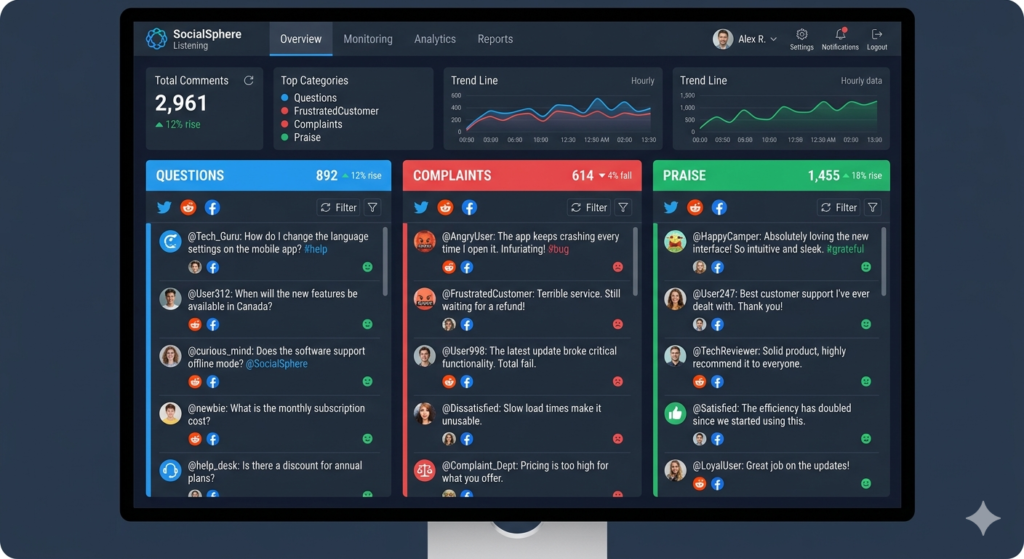
Brand monitoring AI is the use of artificial intelligence tools to continuously scan the internet and social platforms for specific keywords, brand names, or industry terms. It automatically tracks conversations, analyzes the sentiment of the text, and delivers structured data without requiring manual searches.
Unlike basic search queries, AI-driven monitoring understands context. It knows the difference between someone mentioning “Apple” the fruit and “Apple” the tech company, filtering out irrelevant noise and saving you from sorting through useless data.
The Role of Social Listening Automation
Tracking your own business name is just the beginning. The true value of this technology lies in social listening automation. This means setting up systems to listen for broader industry trends, competitor mentions, and customer pain points.
For example, if you are a freelance web designer, you do not just want to know when someone tags your specific agency. You want an alert every time someone posts, “Can anyone recommend a good web designer for an e-commerce site?”
When you capture these broad industry questions, you can use them to fuel your own marketing strategy. In fact, these real-world questions are the perfect raw material for the systems discussed in our guide on How to Build an Automated Content Engine with AI.
Setting Up Automated Alerts
To make this system work, you need to configure your tracking parameters accurately. If your parameters are too broad, you will be overwhelmed by notifications. If they are too narrow, you will miss vital opportunities.
Begin by compiling a list of target phrases. This should include:
- Your brand name (and common misspellings).
- Your personal name.
- Your flagship product or service names.
- Names of your top three competitors.
- High-intent buying phrases in your niche (e.g., “looking for a [your service]”).
Once you have your list, you plug these into a listening tool. Using a platform like Mention or F5Bot allows you to set up precise automated alerts. Instead of checking the app daily, you can configure the software to send you a daily or weekly digest directly to your inbox or Slack channel, summarizing everything that was said.
Proactive Reputation Management
For a one-person business, your reputation is your most valuable asset. A single unanswered complaint on a public forum can deter dozens of potential clients. Conversely, a glowing recommendation that you fail to acknowledge is a missed opportunity to build loyalty.
Continuous AI monitoring enables proactive reputation management. Because the AI can read the “sentiment” of a post (categorizing it as positive, negative, or neutral), you can set up emergency alerts for negative sentiment.
If someone posts a complaint, your system flags it immediately. You can step in, apologize, and resolve the issue publicly before it escalates. When someone posts praise, you can thank them instantly and ask permission to use their words as a testimonial on your website.
Conclusion
Staying informed about your industry does not require sacrificing your productivity to endless scrolling. By implementing brand monitoring AI, you build a tireless digital scout that scours the internet on your behalf. Whether you are tracking competitor movements, hunting for new leads, or protecting your brand’s image, automated listening tools provide the intelligence you need to make fast, informed decisions. Set up your alerts, step away from the feed, and let the data come to you.
Frequently Asked Questions (FAQ)
What is the difference between brand monitoring and social listening?
Brand monitoring is the tactical process of tracking direct mentions of your specific company or product. Social listening is the broader, strategic process of tracking conversations about your entire industry, competitors, and general customer pain points to understand macro trends.
Is Google Alerts enough for brand monitoring?
Google Alerts is a helpful, free tool for tracking basic mentions on indexed websites and news articles. However, it often misses fast-moving conversations on social media platforms, private forums like Reddit, and cannot perform sentiment analysis. Dedicated AI tools offer much deeper coverage.
How do AI tools determine sentiment?
AI tools use Natural Language Processing (NLP) to analyze the words, context, and phrasing of a mention. It looks for positive adjectives (e.g., “love,” “amazing,” “recommend”) or negative phrasing (e.g., “terrible,” “broken,” “frustrated”) to categorize the overall mood of the post automatically.
Can I monitor my competitors using these tools?
Yes. Tracking competitors is one of the most powerful use cases for these tools. You can set up alerts to see when a competitor launches a new product, what their customers are complaining about, or where they are getting press coverage, allowing you to adjust your own strategy accordingly.