Growth is the primary goal of almost every solopreneur. You want more clients, more revenue, and more impact. However, there is a hidden paradox in business growth: as you get bigger, everything gets harder. Processes that worked perfectly when you had two clients suddenly break when you have twenty.
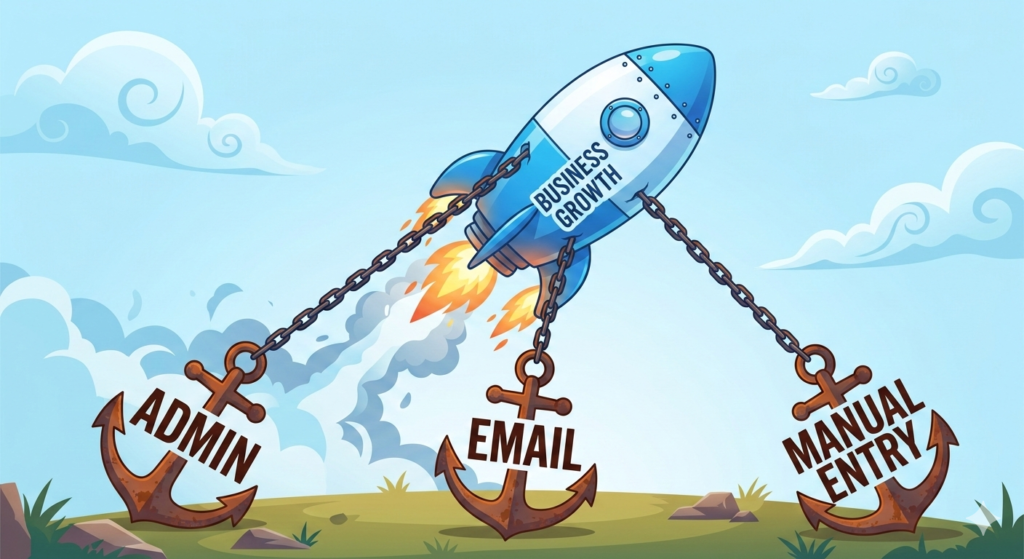
This phenomenon is known as “scaling friction.” It is the invisible force that prevents profitable businesses from growing to the next level, often trapping the founder in a cycle of endless administrative work.
If you feel like you are working twice as hard for the same amount of profit, or if you are turning down work because you physically cannot handle the logistics, you are likely suffering from this common business ailment.
What is Scaling Friction?
To solve the problem, we must first define it clearly.
Scaling friction is the operational resistance a business experiences when its existing systems cannot handle increased demand. It manifests as bottlenecks, errors, and inefficiencies that slow down growth, meaning that for every unit of revenue added, the operational effort required increases disproportionately.
In physics, friction is the force that resists motion. In business, it is the manual work that resists revenue. When scaling friction is high, doubling your revenue requires doubling your work hours—which is impossible for a one-person business.
Identifying Small Business Bottlenecks
Friction usually doesn’t appear overnight. It creeps in slowly as business limitations begin to pile up. Here are the most common signs that your operations are creating drag:
- The “Inbox Trap”: You spend the first three hours of every day just replying to emails, leaving no time for “Deep Work.”
- Quality Control dips: You start making small mistakes, like sending an invoice to the wrong client or forgetting a scheduled call.
- The “Bus Factor”: If you were hit by a bus (or just took a week off), the entire business would grind to a halt because all knowledge and execution live in your head.
- Manual Data Re-entry: You find yourself copying data from an email and pasting it into a spreadsheet or CRM manually.
The Cost of Manual Processes
The primary driver of scaling friction is the reliance on manual inputs for repetitive tasks. When you are just starting, it makes sense to handle things manually because the volume is low. However, manual workflows do not scale.
If it takes you 10 minutes to onboard a new client manually:
- At 1 client a month, it costs you 10 minutes.
- At 10 clients a month, it costs you nearly 2 hours.
- At 50 clients a month, you lose an entire workday just to onboarding.
To break through the ceiling, you must reduce manual data entry and administrative overhead. This requires a shift in strategy—moving from “doing the work” to “designing the system that does the work.”
For a comprehensive look at how to structure this shift, you should read The Solopreneur Automation Blueprint: A Complete Guide.
How to Fix Scaling Friction
Once you have diagnosed the issue, the solution involves removing the points of resistance.
1. Document Your Processes (Standardization)
You cannot fix what you do not understand. Write down every step of your core processes (sales, delivery, finance). Look for steps where information is lost or where you have to intervene manually.
2. Implement Asynchronous Communication
A major source of friction is the “meeting culture.” Real-time meetings are expensive and hard to schedule. Moving to asynchronous communication—where information is exchanged without both parties being present at the same time—removes time zone and scheduling barriers.
This is where video messaging tools become invaluable. For example, using Loom (for async comms) allows you to record a quick screen-share video explaining a complex topic to a client or a freelancer. Instead of typing a long email or scheduling a 30-minute Zoom call, you send a 3-minute video. This significantly reduces the friction of communication and keeps projects moving forward.
3. Automate the Handoffs
Friction usually occurs at the “handoffs”—the moment a lead becomes a client, or a project is marked complete. Use automation tools to bridge these gaps so that data flows without you touching it.
Conclusion
Scaling friction is a natural part of business growth, but it must be addressed immediately. If you ignore the warning signs—like burnout and administrative overload—your business will plateau.
By identifying your small business bottlenecks and leveraging tools for asynchronous communication and automation, you can remove the drag on your rocket ship. The goal is to decouple your time from your income, allowing your business to scale freely while you focus on high-value strategy.
Frequently Asked Questions (FAQ)
What is the difference between growing and scaling?
Growing usually means increasing revenue at the same rate as costs (e.g., hiring more people to do more work). Scaling means increasing revenue significantly while costs (and effort) remain low. Scaling requires removing friction; growth can happen despite it.
How do I know where my biggest bottleneck is?
Look for the task you procrastinate on the most. Usually, we avoid the areas causing the most friction. Alternatively, track your time for a week. The activity consuming the most hours with the least return on investment is likely your biggest bottleneck.
Can software really fix all scaling friction?
Not all of it. Software fixes process friction. However, friction can also come from bad strategy, poor product-market fit, or unclear communication. Software is a multiplier; it makes good processes faster, but it will also make bad processes fail faster.
Is scaling friction only a problem for large companies?
No, it is actually most dangerous for solopreneurs. Large companies have teams to absorb inefficiencies. A solopreneur has limited energy; if 50% of your energy is lost to friction, your business is at significant risk of failing.