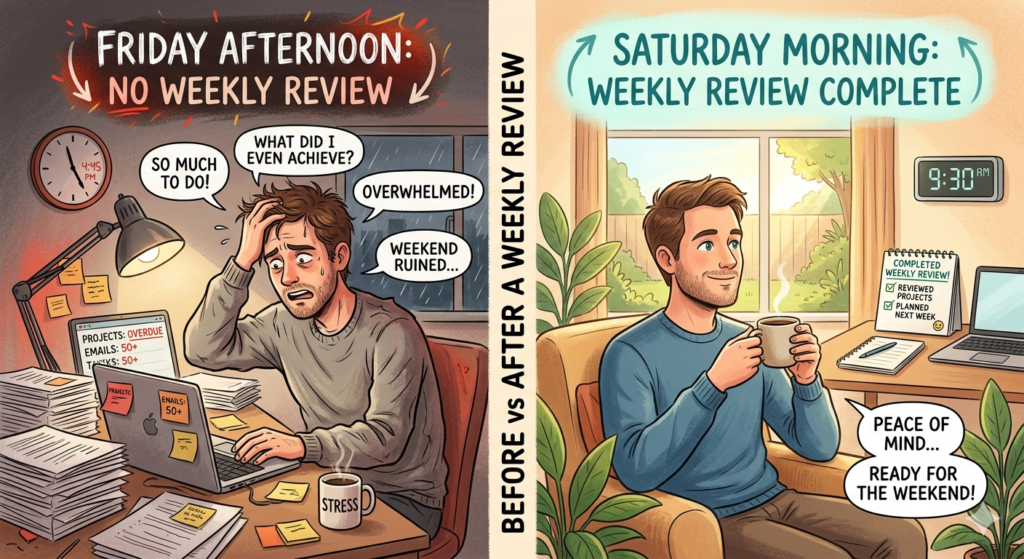
Friday afternoon rolls around, and your energy is entirely depleted. You close your laptop, promising yourself that you will figure out next week’s schedule on Monday morning. However, when Monday arrives, chaos immediately takes over, and you spend the first three hours of your workday just trying to remember what you missed last week.
Skipping your end-of-week reflection is the fastest way to drop the ball on client projects and induce constant weekend anxiety. The human brain cannot accurately hold the status of a dozen different projects at once.
To achieve true peace of mind, you need a scripted routine. This guide will show you how to build a foolproof system that forces you to close out your week properly, ensuring nothing falls through the cracks and you can actually relax during your time off.
What is Weekly Review Automation?
To stop avoiding this critical habit, you must make it effortless to start.
Weekly review automation is the process of using digital templates and recurring reminders to systematize your end-of-week reflection. It involves scheduling software to prompt you with a standardized checklist, ensuring you consistently evaluate past tasks, clear your inboxes, and plan the upcoming week without manual setup.
By relying on a script rather than your memory, you eliminate the cognitive friction of deciding what to review. The software tells you exactly what to look at, step-by-step.
The Core of the GTD Methodology
The concept of a weekly review was popularized by David Allen’s gtd methodology (Getting Things Done). The core philosophy of GTD is that your mind is for having ideas, not holding them.
To maintain a clear mind, your trusted digital system must be accurate and up-to-date. The weekly review is the critical maintenance phase of this methodology. It is the designated time when you empty your head, process your loose notes, and update your project lists.
Without this weekly maintenance, your digital system quickly becomes a digital junk drawer. To ensure your intellectual assets are properly structured before you attempt a review, refer to our foundational guide: Building a Second Brain: A Guide for Creators.
Creating Standardized Reflection Templates
A successful review should not take two hours; it should take 30 minutes. The secret to speed is standardization.
You should not be making up questions on the spot. Instead, utilize reflection templates that guide you through a rapid assessment of your business.
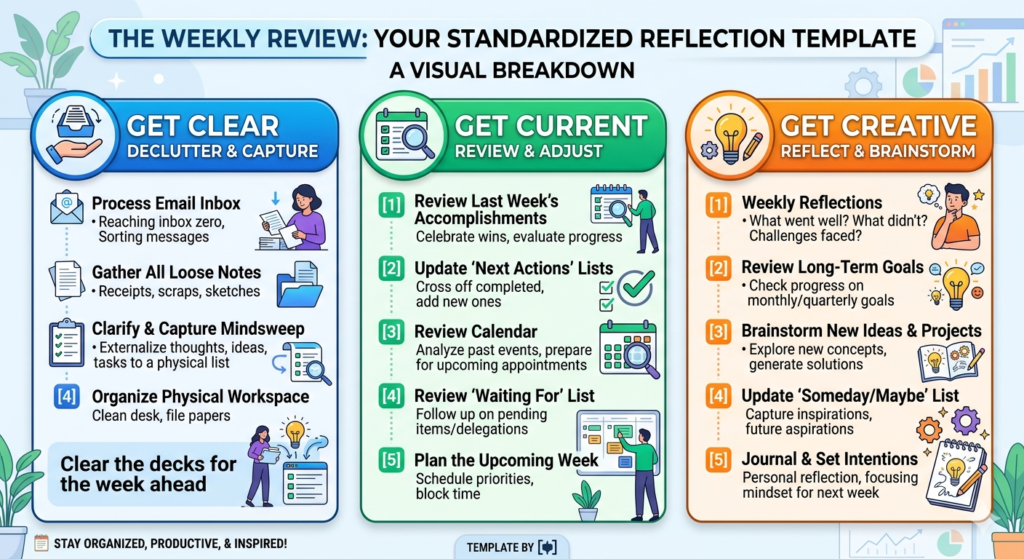
A Standard 3-Part Template
- Get Clear: Process all physical and digital inboxes to zero. Empty your downloads folder, sort your email, and organize any random notes taken during the week.
- Get Current: Review your past calendar to ensure no follow-ups were missed. Look at next week’s calendar to prepare for upcoming meetings.
- Get Creative: Jot down any new, bold ideas for the business that surfaced during the week, moving them out of your active working memory.
Setting Up the Automation Script
Once your template is defined, you must automate its delivery. If you rely on your own willpower to open the template on a Friday at 4:00 PM, you will likely skip it.
You must embed the review into your task manager as an unmovable, recurring event. Using a robust task management platforms like Todoist or TickTick allows you to create a parent task called “Friday Weekly Review” that automatically regenerates every single week.
You can nest your entire reflection template inside this task as a sub-checklist. When Friday afternoon arrives, your phone and computer ping you, the checklist is already populated, and you simply execute the steps one by one.
Streamlining Productivity Tracking
The final component of your review is assessing your output. However, tallying up your completed tasks manually is tedious.
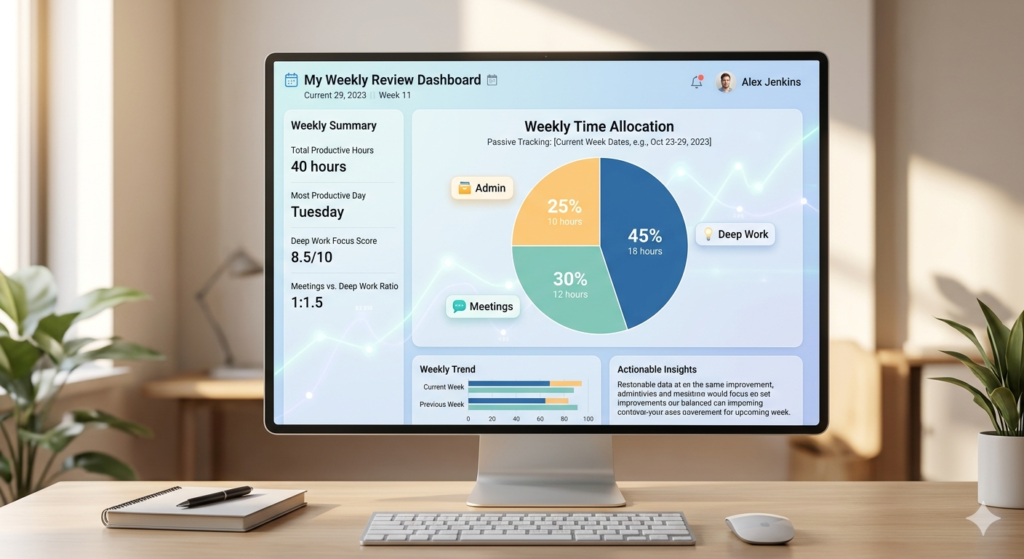
Effective productivity tracking should be passive. By using time-tracking software or reviewing the “completed tasks” log in your project management tool, you can instantly see where your hours went.
This data prevents you from lying to yourself. If you feel like you worked incredibly hard but your tracker shows you spent 15 hours in your email inbox and only two hours on deep work, your automated review has just highlighted a critical bottleneck you can fix for the upcoming week.
Conclusion
Closing out your week properly is the ultimate act of self-care for a business owner. Implementing weekly review automation guarantees that you never face Monday morning blindly. By leveraging the principles of the GTD methodology, utilizing strict templates, and relying on recurring software prompts, you build a safety net for your operations. Script your Friday routine today, and you will finally be able to disconnect and enjoy your weekends with a completely clear mind.
Frequently Asked Questions (FAQ)
What day is best for a weekly review?
Friday afternoon is traditionally the best time for a professional review, as the events of the workweek are still fresh in your mind, and it allows you to truly unplug for the weekend. However, some creators prefer Sunday evening to mentally prepare for Monday morning. Choose the time that fits your energy levels best.
How long should a weekly review take?
A well-scripted weekly review should take between 30 and 45 minutes. If it takes longer than an hour, your system is likely too complex, or you are actually doing the project work during the review rather than simply planning it.
What is the difference between a weekly review and daily planning?
Daily planning is tactical; it involves looking at today’s calendar and picking the top three tasks to execute right now. The weekly review is strategic; it involves looking at the macro-level progress of all your active projects and making sure your daily tasks are still aligned with your big-picture goals.
Should I review my personal life during my business weekly review?
Many solopreneurs find it highly effective to combine them. Since a one-person business is deeply intertwined with personal life, reviewing personal habits (like workouts or family commitments) alongside business metrics ensures your upcoming week is realistically balanced.