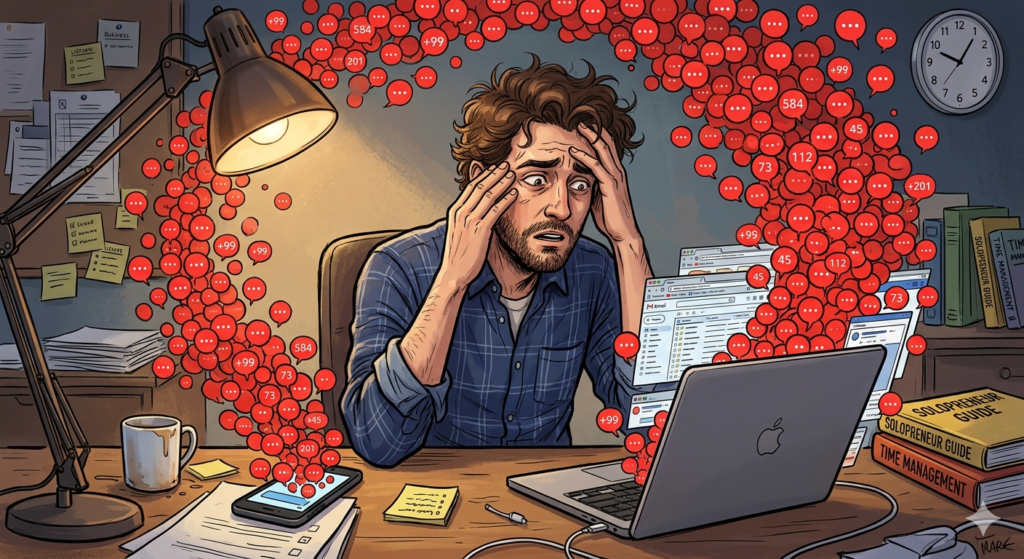
You launched your own business to gain freedom, but instead, you find yourself tethered to your phone. The constant ping of emails, instant messages, and meeting reminders creates an “always-on” culture that makes it impossible to focus. This reactivity drains your energy, limits your revenue potential, and is a primary cause of solopreneur burnout.
For a one-person team, adopting an asynchronous work model is not just a productivity hack; it is a vital survival strategy. By intentionally delaying your responses and restructuring how you interact with clients, you can reclaim your time, reduce your anxiety, and produce your highest-quality work.
This guide explores how to break free from the expectation of instant availability and structure a day that prioritizes deep, meaningful execution.
What is the Asynchronous Work Model?
To escape the trap of real-time communication, we must redefine how collaboration happens.
The asynchronous work model is a system where communication does not happen in real-time. Instead of expecting immediate responses, individuals send messages, assign tasks, or record updates that the recipient can process and reply to later, operating entirely on their own optimal schedule.
It breaks the outdated corporate assumption that working hard means sitting at your desk waiting to answer questions instantly. Instead, it measures success purely by output and the quality of the final deliverable.
The Trap of “Always-On” Communication
Relying on synchronous (real-time) communication forces you to constantly context-switch. Every time you pause a complex project to answer a “quick question” on Slack or via email, your brain loses its train of thought.
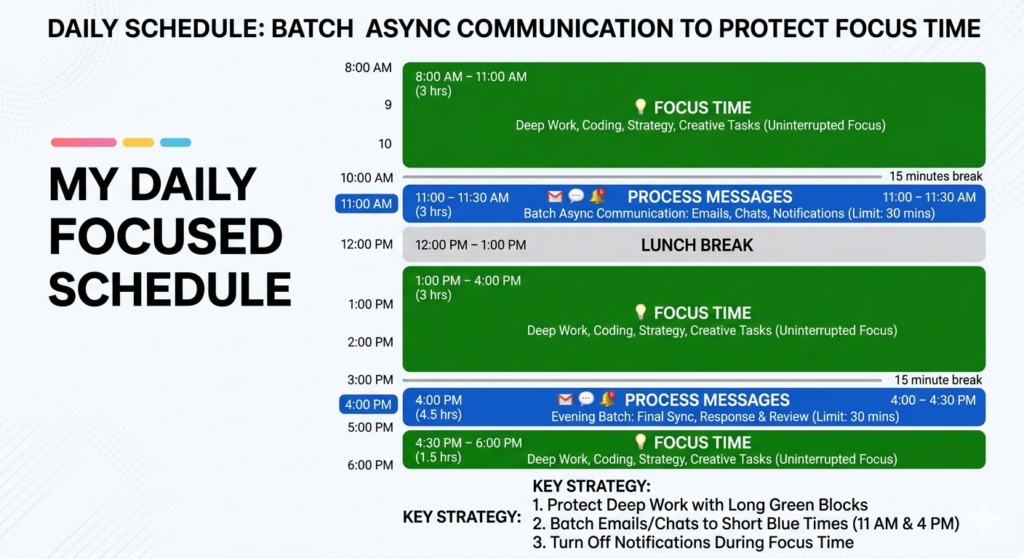
Research suggests it takes nearly 20 minutes to regain full cognitive focus after a single interruption. If you answer ten messages throughout the morning, you have effectively lost hours of productive time. Embracing async communication protects your mental bandwidth. It allows you to batch your replies, processing all your messages in two dedicated 30-minute windows per day rather than remaining perpetually distracted by a flashing inbox.
Leveraging Deep Work Strategies
The primary benefit of delaying your communication is the ability to engage in prolonged, uninterrupted focus. Deep work strategies require large blocks of time where you are entirely disconnected from the outside world.
During these blocks, you can tackle complex problem-solving, strategic planning, or high-level creative execution. To maximize this uninterrupted time, you should not be actively searching for information. You need a pre-organized system to hold your reference materials and ideas so you can execute smoothly. You can learn how to set up this exact intellectual foundation by reading our guide: Building a Second Brain: A Guide for Creators.
How to Eliminate Meetings
For a one-person business, meetings are incredibly expensive. They chop your day into fragmented pieces and rarely result in actionable output. A central goal of your new workflow should be to eliminate meetings that serve only to share status updates or present initial drafts.
Instead of scheduling a 30-minute Zoom call to show a client a website mockup, rely on rich media. Tools like Loom or Twist allow you to record a detailed screen-share video narrating your work. You can point out specific details and provide rich context without needing to coordinate two busy calendars. The client can watch the video on their own time, rewind if necessary, and leave highly targeted, written feedback.
Setting Boundaries and Client Expectations
Transitioning to this model requires clear, upfront boundary setting. If your existing clients are used to you replying within five minutes, a sudden silence will cause them anxiety and erode trust.
You must proactively define your communication rules in your initial contracts and onboarding materials.
- Define Your Hours: State clearly that you perform deep work in the mornings and only check messages in the afternoons.
- Establish an SLA (Service Level Agreement): Guarantee a 24-hour response time for standard inquiries.
- Provide an Emergency Protocol: Give them a specific way to reach you (like a direct phone call) strictly for true, business-halting emergencies.
When clients know exactly when to expect an answer, their urgency decreases, and they easily adapt to your structured, professional workflow.
Conclusion
Adopting an asynchronous work model is a profound shift in how you operate a one-person business. It requires discipline to ignore notifications and clear communication to manage client expectations, but the reward is total control over your daily schedule. By stepping away from the “always-on” mentality and fiercely protecting your deep work blocks, you will produce higher quality output, reduce your stress, and finally experience the operational freedom you started your business to achieve.
Frequently Asked Questions (FAQ)
Is asynchronous communication rude to clients?
No, it is highly professional. Providing a thoughtful, comprehensive, and accurate answer 12 hours later is much better for the client than providing a rushed, distracted, and potentially incorrect answer within two minutes.
Can sales or discovery calls be asynchronous?
Generally, no. Initial sales conversations, discovery calls, and final contract negotiations benefit heavily from real-time rapport building and the ability to read immediate emotional reactions. Keep sales synchronous, but make project delivery asynchronous.
What if my clients refuse to work asynchronously?
If a client demands constant, instant access to you throughout the day, they are looking for a full-time employee, not a freelance partner. You have to decide if their retainer is worth the disruption to your other projects. Often, “always-on” clients are not a good fit for a scalable solopreneur business.
How do I stop the habit of constantly checking my email?
Breaking the habit requires physical barriers. Remove the email app and Slack from your smartphone’s home screen. Use website blockers on your computer to lock yourself out of your inbox during your designated deep work blocks.