Traditionally, scaling a business meant one thing: hiring more people. To double your revenue, you had to double your staff, secure larger office spaces, and navigate complex human resources logistics. For many solopreneurs, this path to growth destroys the very freedom and agility they started their business to achieve.
Today, a new paradigm has emerged. Technology has decoupled revenue generation from human headcount. By leveraging artificial intelligence and interconnected software, a single founder can now manage the output of an entire agency.
This guide provides a high-level overview of how to scale a business with ai. It explores the strategies required to transform from an overwhelmed freelancer into the director of a highly profitable, one-person conglomerate.

What is a One-Person Conglomerate?
Before restructuring your operations, we must define this modern business model.
To know how to scale a business with AI means transitioning into a “one-person conglomerate.” This is a highly leveraged business model where a single human founder directs a digital workforce of AI agents and automated software to execute complex, multi-departmental operations without hiring traditional employees.
In this model, you are no longer the operator doing the manual labor. You are the architect, responsible for building the systems, setting the strategy, and managing the automated output.
Essential Scaling Strategies
You cannot scale a chaotic operation, regardless of how much technology you apply to it. Before deploying advanced AI, you must fundamentally change how you deliver value to the market.
Productizing Your Services
The most critical of all scaling strategies is to stop charging by the hour. When your income is tied to the clock, your revenue is permanently capped. You must package your expertise into standardized, repeatable offerings. Whether it is a fixed-price website build, a comprehensive digital course, or a specialized consulting sprint, productizing ensures that delivering to ten clients takes roughly the same effort as delivering to one.
Decoupling from Real-Time Dependencies
If your business requires you to be on live calls all day, you cannot scale. You must remove real-time dependencies by transitioning to asynchronous communication and standardized onboarding systems.
Leveraging Business Growth Automation
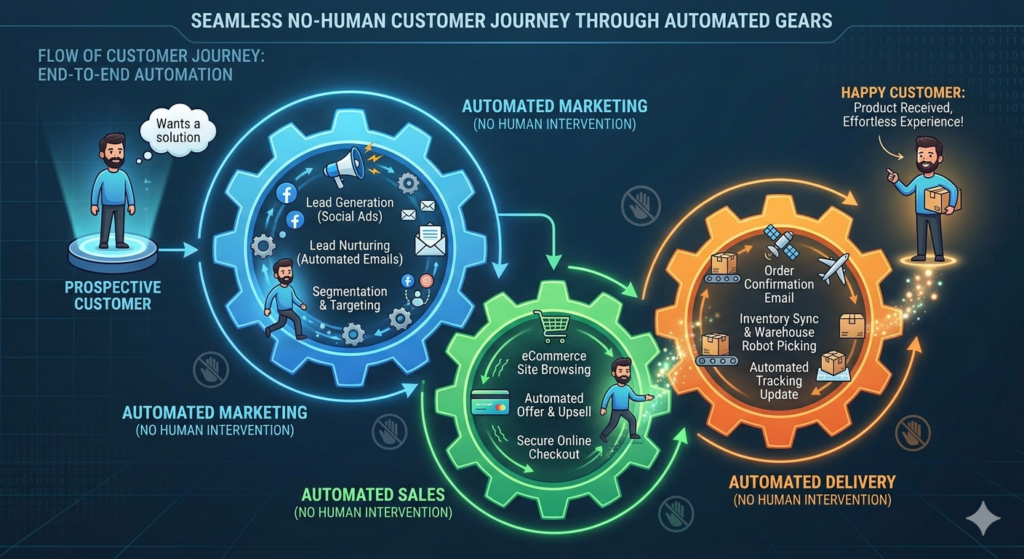
Once your offering is standardized, you must automate small business tasks across every administrative department. A conglomerate requires flawless backend logistics.
To achieve this, you build digital pipelines. Marketing lead generation, client onboarding, invoicing, and file organization must happen without your physical input. This is known as business growth automation.
When the backend runs silently, the founder can focus 100% of their energy on high-level strategy and traffic generation. The software acts as your invisible administrative staff, ensuring that a sudden influx of new customers does not break your company’s infrastructure.
Deploying Your Digital Workforce
The true leverage of the modern era is artificial intelligence. AI models now possess the capability to perform cognitive tasks that previously required human interns or junior staff.
Instead of hiring a copywriter, a data analyst, and a research assistant, you deploy large language models. By utilizing secure, advanced platforms like ChatGPT Team or Claude, a solo founder gains a dedicated workspace where the AI remembers brand guidelines, analyzes large datasets, and drafts professional communications.
The Manager Mindset
Operating this digital workforce requires a fundamental shift in daily behavior. You must stop starting from a blank page. Your job is to write detailed instructions (prompts), feed the AI the necessary context, and then act as an editor. You review the output, refine the nuances, and approve the final product.

The Financial Economics of AI Scaling
The traditional agency model suffers from margin compression. As revenue grows, the cost of payroll, benefits, and office space grows alongside it, keeping profit margins relatively thin.
The one-person conglomerate flips this economic model entirely. The cost of an enterprise AI subscription and premium automation software is a fraction of a single human employee’s salary. Once this fixed technological cost is covered, nearly every additional dollar of revenue generated goes directly to the bottom line as profit. This allows a solo operator to achieve the financial footprint of a much larger corporation.
Conclusion
Understanding how to scale a business with ai is about redefining the boundaries of what a single human can achieve. By standardizing your services, relying heavily on business growth automation, and managing a digital workforce, you can handle enterprise-level volume entirely on your own. Building a one-person conglomerate allows you to maximize your revenue, preserve your profit margins, and most importantly, protect your personal freedom.
Frequently Asked Questions (FAQ)
What is the revenue limit of a one-person business?
With the integration of automated delivery and AI, there is no strict technical limit. Many solopreneurs running highly optimized digital product businesses or productized service agencies now generate millions of dollars in annual revenue without full-time employees.
Do I need to know how to code to build this model?
No. The entire digital infrastructure of a one-person conglomerate can be built using “no-code” automation tools, drag-and-drop website builders, and conversational AI interfaces that require zero programming knowledge.
How do I handle customer support at scale without employees?
Customer support is handled proactively through comprehensive self-service client portals, detailed FAQ documentation, and automated email sequences. For complex issues, AI-driven helpdesk tools can triage and answer the majority of tickets, leaving only the most nuanced problems for the founder to address personally.
Will AI replace my core expertise?
AI will not replace your unique perspective, your industry relationships, or your overarching strategic vision. AI is a tool for execution. It handles the heavy lifting of drafting, organizing, and analyzing, while you provide the essential human element of direction and empathy.