The modern narrative of the solo founder often glorifies endless hustle. When your name is on the virtual door, it is easy to justify working late into the night, answering emails on weekends, and skipping vacations. However, relying purely on willpower and long hours is a fragile strategy. Eventually, the mind and body will force a hard stop.
When you hit the wall of exhaustion, your business stalls alongside you. Implementing proactive solopreneur burnout solutions is not a luxury; it is a critical operational requirement. Instead of just trying to “push through,” the most resilient founders use software and strategic systems to buy back their rest.
This guide explores how to identify the early warning signs of exhaustion and deploy automated solutions to protect your most valuable business asset: your own energy.

What is Solopreneur Burnout?
To address the problem effectively, we must first understand what we are fighting against.
Solopreneur burnout is a state of chronic physical and emotional exhaustion caused by prolonged stress in a one-person business. It manifests as severe fatigue, cynicism, and a sharp decline in professional performance, ultimately hindering a founder’s ability to maintain a sustainable work pace.
It is important to note that burnout is not the same as simply being tired after a busy week. A tired founder recovers after a good night’s sleep; a burned-out founder wakes up just as exhausted as they were the night before.
Recognizing the Early Warning Signs
Prioritizing mental health for entrepreneurs begins with awareness. Burnout rarely happens overnight. It creeps in slowly, often disguised as temporary stress.
Watch for these three critical warning signs:
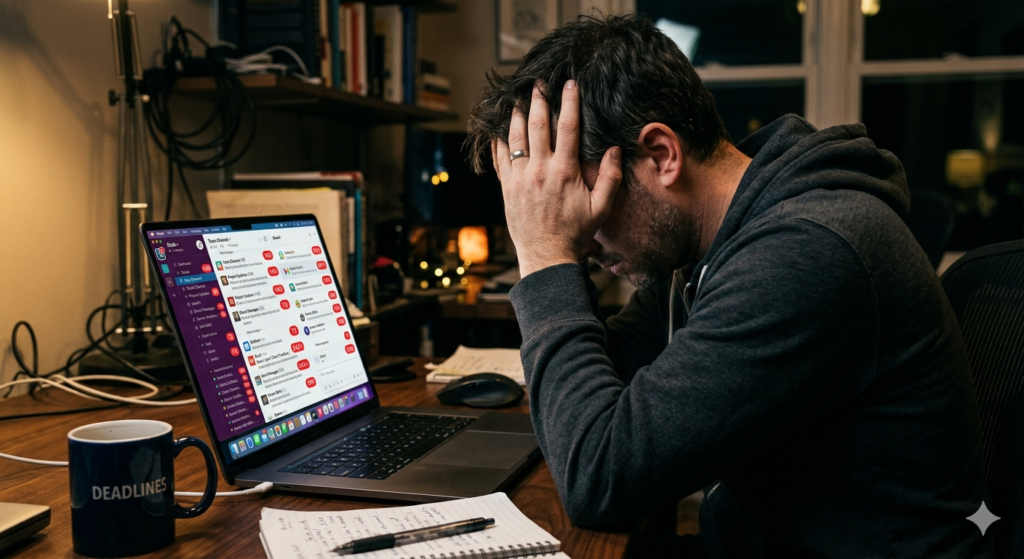
- The Inbox Dread: You feel a spike of physical anxiety or nausea simply by looking at the notification badge on your email or messaging apps.
- Apathy and Cynicism: You lose empathy for your clients. Interactions that used to be enjoyable now feel like massive, irritating burdens.
- Cognitive Decline: You start making careless mistakes. You miss deadlines, forget routine tasks, and struggle to focus on simple problem-solving.
When these signs appear, you cannot solve the issue by working harder. You must change the way the work gets done.
Outsourcing vs Automation: Finding Relief
When a solo founder realizes they have too much to do, they face a common dilemma: outsourcing vs automation. Understanding which path to take is crucial for immediate relief.
Outsourcing involves hiring a human, such as a virtual assistant or a freelancer. While helpful in the long term, bringing on a human requires you to write training manuals, conduct interviews, and manage their daily output. When you are already burned out, the mental overhead of managing another person can actually increase your stress initially.
Automation, conversely, does not require management or sick days. You set up a software rule once, and it runs indefinitely in the background. Therefore, the smartest strategy is to automate every repetitive task first. Only after the robotic tasks are delegated to software should you consider hiring human help for complex problem-solving.
To understand how to elevate this strategy into a complete business model, refer to our comprehensive guide: Scaling a Business with AI: The One-Person Conglomerate.
Automated Solutions to Buy Back Rest
The goal of automation in this context is not to cram more work into your day. The goal is to create empty space in your calendar for recovery.
1. Automating Client Boundaries
Burnout is often fueled by clients demanding 24/7 access. You can use automated email filters and auto-responders that trigger only outside of your working hours. The system politely informs the client that you have received their message and provides an exact timeline for when you will review it on the next business day.
2. Eliminating Friction in Delivery
Use software to handle the logistics of your business. When invoices send themselves and digital files are automatically routed to the correct client portals, you remove hours of administrative drag from your week.
3. Enforcing the Disconnect
Once your systems are running the backend, you must actually use the bought-back time to disconnect. Integrating mindfulness tools into your daily routine helps reset your nervous system. You can even use website blockers to physically lock yourself out of your business applications during your designated recovery time.
Establishing a Sustainable Work Pace
Technology alone cannot fix a fundamentally broken business model. Automation provides the leverage, but you must establish the boundaries.
A sustainable work pace means designing a schedule that you could comfortably maintain for the next five years. It requires you to cap your working hours strictly, schedule mandatory breaks, and refuse to take on more clients than your automated systems can comfortably handle.
Remember, taking time off is not a reward for burning yourself out. Rest is the required maintenance that allows you to perform at a high level.
Conclusion
Ignoring the limits of your own energy is a dangerous operational strategy. By recognizing the early warning signs and actively deploying solopreneur burnout solutions, you protect the longevity of your business. Use software to handle the repetitive administration, set rigid boundaries around your availability, and prioritize genuine recovery. A rested, focused founder is infinitely more productive than an exhausted one.
Frequently Asked Questions (FAQ)
Is burnout a sign I should quit my business?
Not necessarily. Burnout is a sign that your current operational system is failing, not that your overall business idea is flawed. Restructuring your workflow, raising your prices, and automating administrative tasks can often save a business you used to love.
How quickly can automation relieve burnout?
Some relief is immediate. Setting up an automated intake form or an out-of-office boundary takes an hour and pays dividends the very same day. However, fully recovering from severe burnout can take weeks or months of sustained, reduced workload.
Should I hire a VA or automate first?
Always automate first. Software is significantly cheaper and faster to implement than human labor. Automate everything that follows a strict rule. Once the robots are handling the data, hire a VA to handle the nuanced tasks that require human judgment and empathy.
Can technology actually make burnout worse?
Yes, if used incorrectly. If you use automation to free up 10 hours a week, and then immediately fill those 10 hours with more client work, you will accelerate your burnout. The technology must be used intentionally to create space for rest.