Every business owner eventually realizes that the key to growth is delegation. Historically, this meant hiring human employees and handing them a training manual. Today, the modern solopreneur delegates cognitive tasks to advanced software. However, artificial intelligence is only as intelligent as the instructions it receives.
If you feed an AI vague, unstructured requests, you will receive generic, unusable output. To get professional, reliable results, you must treat your digital workforce with the same rigor you would apply to a human team. You must develop a formalized sop for small business operations specifically designed for your AI tools.
This guide explains how to merge traditional business documentation with prompt engineering, allowing you to write crystal-clear instructions that guarantee consistent, high-quality output from your AI agents.

What is an SOP for a Small Business?
To effectively command an AI, we must define the framework of our instructions.
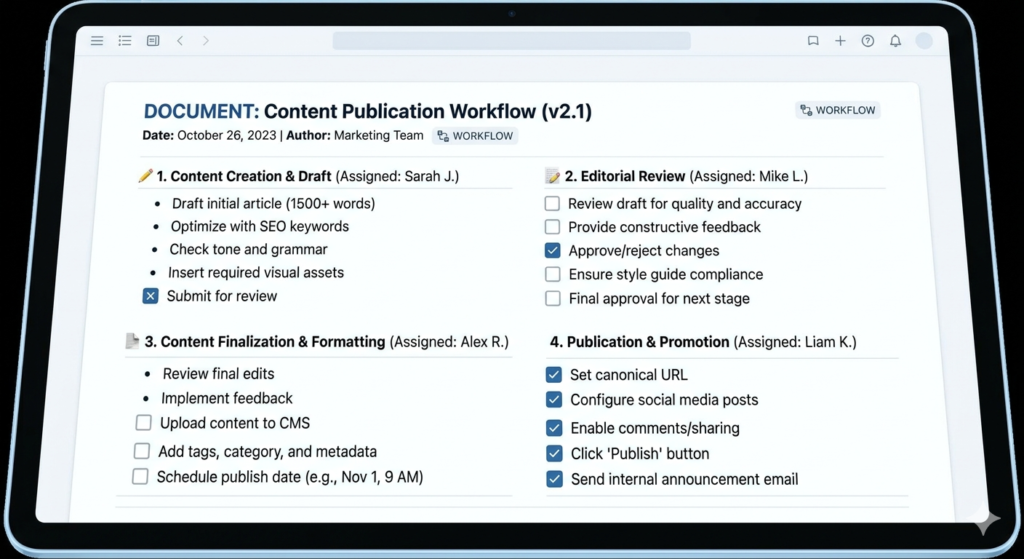
An SOP for small business is a standardized, step-by-step set of instructions that details how to execute a specific routine task. It ensures operational consistency, reduces errors, and provides a clear framework for training employees or programming artificial intelligence agents effectively.
In the context of modern technology, an SOP is no longer a dusty binder sitting on a shelf. It is an active script—a meticulously crafted master prompt—that dictates exactly how a digital assistant should behave, format data, and solve problems.
The Shift: From Human Employees to AI Agents
Transitioning from a manual operator to the manager of a digital workforce requires a strategic mindset shift. Humans can infer meaning, read between the lines, and use common sense to fill in the gaps of a poorly written manual. AI agents cannot.
AI models operate on strict pattern recognition based entirely on the text you provide. If you leave out a crucial boundary or context clue, the AI will confidently hallucinate an incorrect solution. Therefore, prompt engineering must evolve from a casual chat into formal business documentation.
To fully understand the architecture of this highly leveraged business model, review our comprehensive guide on Scaling a Business with AI: The One-Person Conglomerate.
Process Mapping: The Foundation of Good Prompts
You cannot write an effective instruction for an AI if you do not deeply understand the task yourself. Before you type a single prompt, you must engage in thorough process mapping.
Process mapping involves breaking down a routine task into its smallest logical components.
- Inputs: What raw data will the AI receive? (e.g., a rough draft, a meeting transcript).
- The Transformation: What exact steps must the AI take to manipulate that data?
- Outputs: What should the final format look like? (e.g., a 300-word email, a JSON code block).
By visually mapping these steps on a whiteboard or a digital canvas, you identify potential fail points. This ensures your final written instruction is logically sound from beginning to end.
Documentation Best Practices for Training AI
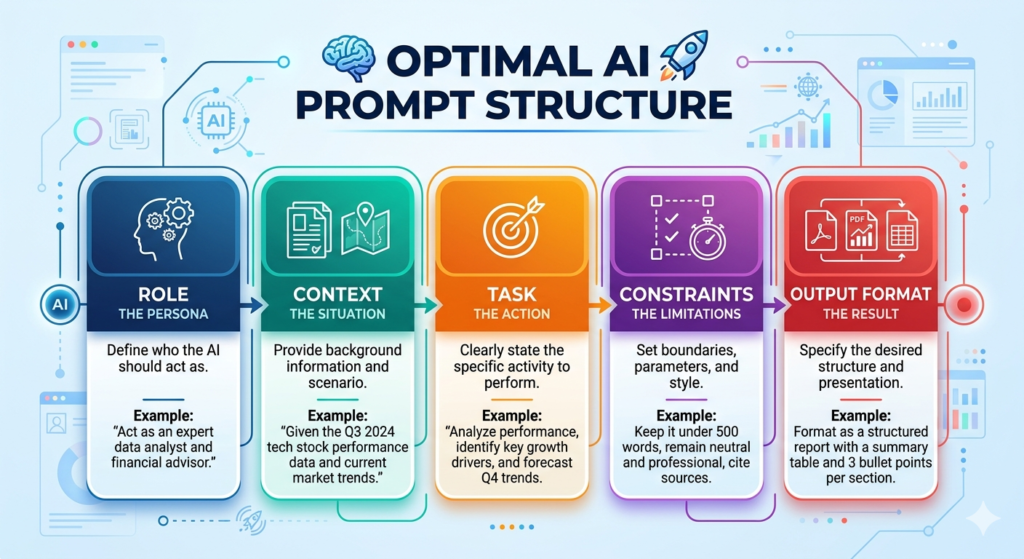
Once the process is mapped, you must translate it into text. Training AI requires you to adopt specific documentation best practices that leave zero room for ambiguity.
- Assign a Role: Always start your SOP by defining the AI’s persona. (“Act as a senior technical copywriter.”)
- Use Delimiters: Use specific symbols (like
###or""") to clearly separate your instructions from your raw data input. - Define Negative Constraints: Telling an AI what not to do is often more important than telling it what to do. (“Do not use the words ‘synergy’ or ‘revolutionary’.”)
Capturing your existing workflows to build these prompts does not have to be manual. Software tools like Scribe allow you to record your screen while you perform a task. The software automatically translates your clicks and keystrokes into a written, step-by-step document. You can then feed this automatically generated document directly to an AI as the foundational context for its new role.
Conclusion
A digital workforce is highly efficient, but it requires masterful management. Establishing a robust sop for small business operations is the only way to guarantee that your AI tools function reliably at scale. By mastering process mapping, enforcing strict documentation practices, and structuring your prompts logically, you transform unpredictable language models into highly disciplined digital employees. Write your instructions clearly, test your outputs, and secure your operational consistency.
Frequently Asked Questions (FAQ)
What is the difference between a prompt and an AI SOP?
A simple prompt is a one-off request, such as “Write an email about my new product.” An AI SOP (or Master Prompt) is a heavily structured document that includes the brand voice, formatting constraints, background context, and step-by-step logical instructions meant to be used repeatedly for a specific business process.
How often should I update my AI SOPs?
You should review and update your SOPs whenever a process changes, or whenever the underlying AI model receives a major update. Because AI platforms evolve rapidly, a prompt that worked perfectly six months ago might yield different results on a newer model and require slight tweaking.
Can an AI agent write its own SOP?
Yes, you can use AI to assist in writing the documentation. If you provide a rough brain-dump of how you execute a task, you can prompt an AI to “Format these rough notes into a strict, step-by-step standard operating procedure document.” You then review and refine the output.
Why does the AI sometimes ignore my instructions?
If an AI ignores instructions, your prompt is likely too long, contradictory, or lacks strict negative constraints. AI models suffer from “context window degradation,” where they might forget instructions placed at the very beginning of a massive document. Place your most critical constraints at the very end of the prompt to ensure they are prioritized.