Every successful solopreneur eventually faces a breaking point where the volume of work exceeds their physical capacity. When you have optimized your personal schedule and maximized your output, the only way forward is to delegate. However, the modern founder faces a unique operational dilemma: do you hand the task over to a piece of software, or do you hire a human being?
Navigating the choice to automate vs outsource is one of the most consequential economic decisions you will make for your business. Making the wrong choice can lead to bloated payrolls, frustrated clients, or broken technical systems.
This guide provides a clear, objective economic breakdown of bots versus humans, helping you decide exactly where to deploy capital to scale your operations safely.

What Does It Mean to Automate vs Outsource?
To make an informed decision, we must clearly define the parameters of both strategies.
The choice to automate vs outsource is a strategic decision between using software to execute repetitive, rule-based processes automatically, or hiring human talent to manage tasks that require empathy, critical thinking, and nuanced judgment. Both methods increase operational capacity but require fundamentally different management styles.
Automation scales logic and speed infinitely without fatigue. Outsourcing scales human ingenuity and relationship-building, but introduces the complexities of human resources.
The True Cost of Automation
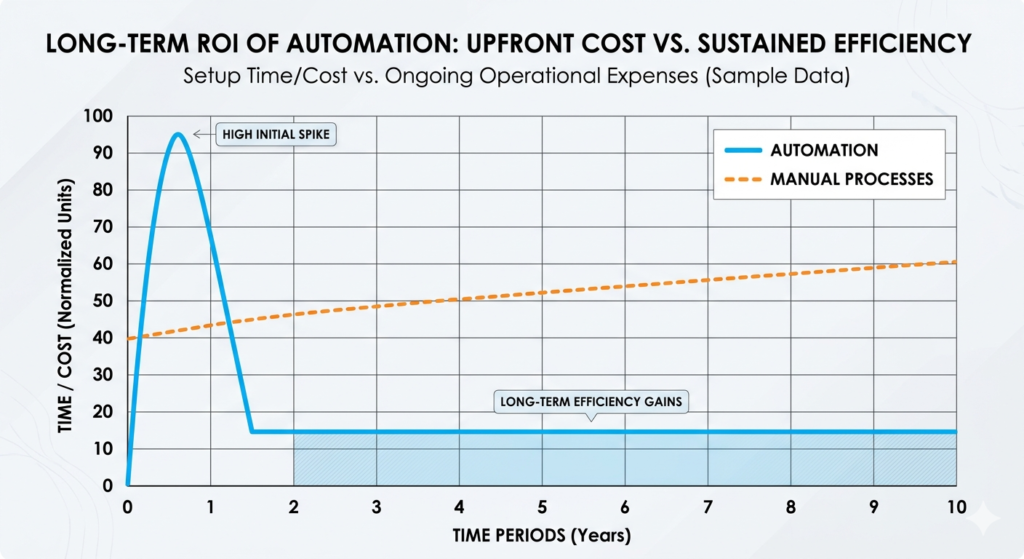
Software is often perceived as the cheaper option, but treating it as “free” labor is an operational mistake. While a software subscription is generally less expensive than a monthly salary, you must calculate the total cost of automation.
The primary cost of automation is the upfront investment of your own time. You must map the process, build the integration, and thoroughly test the system to ensure data flows correctly. Once established, the marginal cost of running that task an additional 1,000 times is virtually zero.
However, you must also factor in maintenance. APIs change, software gets updated, and connections break. Your ongoing cost is the technical auditing required to ensure the system does not fail silently.
Identifying Virtual Assistant Tasks
While software excels at moving data, it fails spectacularly at managing nuance. If a process requires judgment, emotional intelligence, or handling ambiguous instructions, you must deploy a human.
Common virtual assistant tasks include managing sensitive customer support inquiries, conducting qualitative market research, or performing final quality assurance checks on deliverables. A human can look at an email and realize the client is frustrated, whereas a standard bot simply reads the text.
You should hire a human when the cost of an error is high, or when the task requires relationship building. An automated onboarding sequence is efficient, but a dedicated virtual assistant checking in to ensure a high-ticket client feels supported adds premium value.
The Economics of Hiring Freelancers
When building your team, you do not necessarily need to hire full-time employees. The gig economy allows you to purchase human expertise in highly specific, manageable increments.
The strategy of hiring freelancers shifts your expenses from fixed payroll overhead to variable project costs. For example, finding specialized talent on platforms like Upwork allows you to bring in an expert designer for a two-week sprint without committing to a long-term contract.
This model blends perfectly with an automated backend. To understand how to orchestrate a system where human freelancers and digital bots work side-by-side, read our comprehensive guide on Scaling a Business with AI: The One-Person Conglomerate.
The Decision Framework: Bot or Human?
To simplify your delegation strategy, apply this basic operational matrix:
- Rule-Based + High Volume = Automate. (Examples: Data entry, invoice generation, file sorting).
- Judgment-Based + High Volume = Outsource (VA). (Examples: Inbox triage, basic customer support, scheduling dynamic appointments).
- Judgment-Based + High Skill = Outsource (Specialist). (Examples: Custom graphic design, complex tax accounting, legal review).
If a task can be mapped out in a strict “If this, then that” flowchart, give it to a bot. If the flowchart requires a box labeled “Use your best judgment,” give it to a human.
Conclusion
The debate to automate vs outsource is not about which method is superior; it is about which tool is appropriate for the job. Software provides speed, consistency, and infinite scalability at a low ongoing cost. Humans provide empathy, adaptability, and critical thinking. By carefully auditing your operational bottlenecks and applying the correct resource to the correct problem, you can scale your business efficiently without sacrificing the quality of your output.
Frequently Asked Questions (FAQ)
Is it riskier to outsource or to automate?
They carry different types of risk. Automation carries technical risk; a broken system can corrupt data instantly at scale. Outsourcing carries management risk; a human may misunderstand directions or quit unexpectedly. Both require oversight and proper documentation to mitigate these risks.
Can I automate a task that a freelancer is currently doing?
Yes, and you often should. If you are paying a human hourly to do basic copy-pasting or data entry, you are wasting capital. Automate the data entry portion, and reallocate the freelancer’s paid hours to higher-level, strategic tasks that actually require their human intellect.
Do I need to be technically skilled to manage freelancers?
No, but you do need to be a skilled communicator. The most common point of failure when hiring a freelancer is poor delegation. You must provide crystal-clear expectations, defined scope, and measurable outcomes to ensure you receive a good return on your investment.
At what revenue point should I start hiring freelancers?
There is no specific revenue threshold. You should hire a freelancer when the cost of their time is significantly less than the value of your time. If you can generate $150 per hour doing client work, it makes economic sense to pay a freelancer $30 per hour to handle your administrative tasks.